
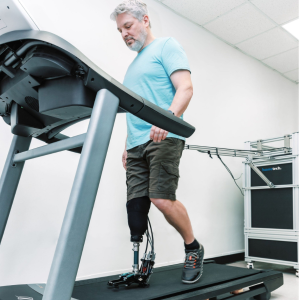
 Choosing a prosthetic limb is a life-altering decision, yet patients rarely get the chance to evaluate their options before committing. Designs vary widely in performance and price, often costing as much as a new car without the option to test-drive or return the device. Historically, clinicians have had little choice but to rely on experience and subjective feedback to guide selection. Humotech changes that equation by allowing patients to physically test-drive different prosthetic designs while generating objective, patient-specific data to help clinicians make the right choice the first time.
From One Better Foot to Every Foot
Drawn to mechanisms, control systems, and robotics from an early age, Josh Caputo initially envisioned building a better prosthetic foot during his doctoral work at Carnegie Mellon University (CMU). But working alongside clinicians and patients led him to a more fundamental realization. The prosthetics industry did not necessarily need another foot. With hundreds of options already available, clinicians simply needed a reliable way to determine which design would work best for each person. That insight led Caputo to shift his focus from developing a single prosthetic to creating a robotic platform that could emulate many designs and help personalize the selection process.
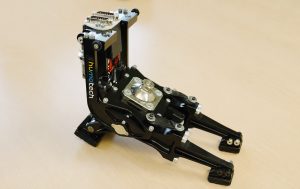
Founded in 2015, Humotech has developed the Caplex System, a wearable robotic platform capable of emulating thousands of prosthetic foot profiles through a single device. Today, more than 47 research and development institutions across North America and Europe rely on the platform, with key installations at Veterans Affairs and Department of Defense (War) facilities. Now, after more than a decade of rigorous testing and validation, Humotech is entering its next phase, bringing its technology from the lab into prosthetics clinics through a clinical trialing service designed to make personalized, evidence-based foot selection a standard part of care.
Building with Robotics Factory
For Humotech, Robotics Factory served as a key satellite location, offering both the advanced manufacturing tools and the hands-on engineering expertise needed to turn concepts into production-ready hardware. Through the 2025 Scale Residency, Humotech engineers fabricated aluminum frame components, prototyped new electronic designs, and CNC-machined specialized carbon fiber parts. Beyond equipment, guidance from robotics technician Luca DeGroot and the broader engineering team helped Humotech navigate complex technical challenges in real time.
That practical experience proved especially valuable as Humotech worked to scale. Robotics Factory mentors helped the company transition away from tribal knowledge by providing templates and guidance to build standardized work instructions and manufacturing documentation. Converting hundreds of pages of unwritten processes into formal documentation reduced dependence on single individuals, created seamless handoffs from engineering to production, and established the foundation required for medical device compliance.
“The Scale program forced us to get serious about our documentation. We had the expertise, but needed to formalize it.”
— Josh Caputo, Founder & CEO, Humotech
 A Technical Sounding Board
 A Technical Sounding Board
The relationship also gave Humotech a technical sounding board for the challenges that come with developing novel hardware. Robotics Factory staff helped the team make its systems more compact, navigate specialized manufacturing questions, and identify potential pitfalls before they became costly problems. When expertise fell outside Humotech’s core capabilities, the team could tap into Robotics Factory’s wider network for guidance on everything from carbon fiber machining and motor drives to footwear manufacturing and suppliers. Paired with the strategic business guidance and supplier/designer sourcing from Robotics Factory Accelerate, this collaboration gave Humotech the operational maturity and ecosystem support needed to successfully scale.
Rooted in Pittsburgh’s Robotics and Healthcare Ecosystem
Pittsburgh’s unique strengths in cutting-edge robotics and world-class healthcare have helped shape Humotech from its earliest days. The company continues to leverage strong research and talent pipelines with CMU, while a partnership with the University of Pittsburgh offers direct access to physicians, prosthetists, and amputees. That regional ecosystem now extends directly into front-line healthcare delivery. Through a flagship pilot with ēlizur, a top regional provider, patients are actively using the Caplex System to evaluate prosthetic options before committing to a final purchase. Coupled with research initiatives alongside Penn State Health to validate real-world patient outcomes, Humotech is building the clinical proof points required to establish hardware emulation as a new standard of care.
Taking the TestDrive on the Road
Today, Humotech is accelerating clinical adoption with the debut of its first Mobile Clinic, commercializing an on-demand prosthetic “TestDrive” service across the region. The service integrates seamlessly into clinical workflows to generate the data needed for evidence-based care while extending reach to rural communities. Following a decade of rigorous development, Humotech is stepping out of the lab and into the market, shifting from a proven research platform into a new standard of care.