
 Engineer and entrepreneur Georgia Crowther has built a career solving complex problems across aerospace, advanced manufacturing, and robotics — from developing urban bikeshare technology and designing wheels for NASA’s VIPER lunar rover, to pioneering large-format bioplastic 3D printing. That work exposed a systemic failure in how engineered materials are handled: advanced manufacturers struggle to source high-quality recycled material even as enormous volumes of valuable plastic are routinely landfilled.
Crowther founded Reclamation Factory in 2024 to reengineer the economics of material recovery. Early field tests exposed a critical flaw in the industry’s legacy approach: nearly all sorting technologies rely on visual or hyperspectral imaging, which routinely fails to identify black plastics, highly pigmented resins, and shredded materials. Rather than refine an inadequate approach, Crowther and her team abandoned traditional optics altogether, pivoting to Acoustic AI — patent-pending technology that classifies plastic resins and additives by how materials sound rather than how they look, regardless of color, size, or shape.
“The Robotics Factory network was incredibly important for us. One of our program mentors is now an active company advisor.”
— Georgia Crowther, Founder & CEO, Reclamation Factory
Solution
The 2024 Robotics Factory Accelerate program helped Crowther and her team turn an ambitious vision into an actionable business plan. That strategic focus carried Reclamation Factory into the 2025 Robotics Factory Scale program, where the company used Scale Shop resources to rapidly prototype and automate its recycling platform with hands-on support from the Robotics Factory team. Led by electromechanical engineer Andrew Katon, Robotics Factory helped with digital controls, circuit design guidance, and custom components fabricated on the fiber metal laser cutter — letting Reclamation Factory iterate quickly while generating the process data it needed to advance the technology.
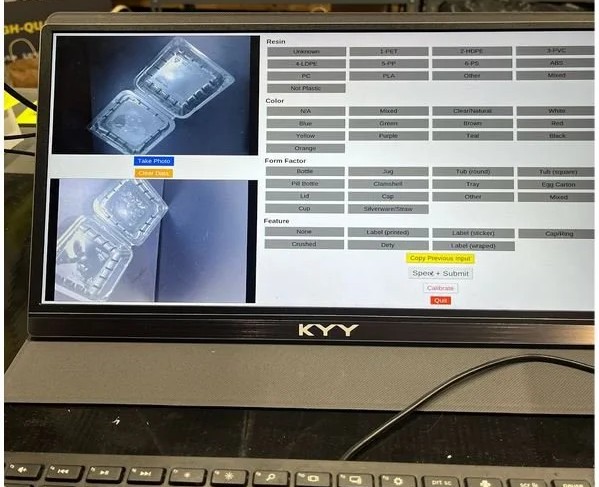
A defining moment came during the 2025 PGH Lab 10.0 pilot with the City of Pittsburgh. Testing against real municipal waste streams showed that conventional optical systems consistently failed to identify black plastics, clamshell containers, pill bottles, and other difficult materials, contaminating recycled feedstocks. Encouraged by Robotics Factory advisors and outside mentors, Crowther and her team set out to test whether plastics could be identified by sound instead of sight.
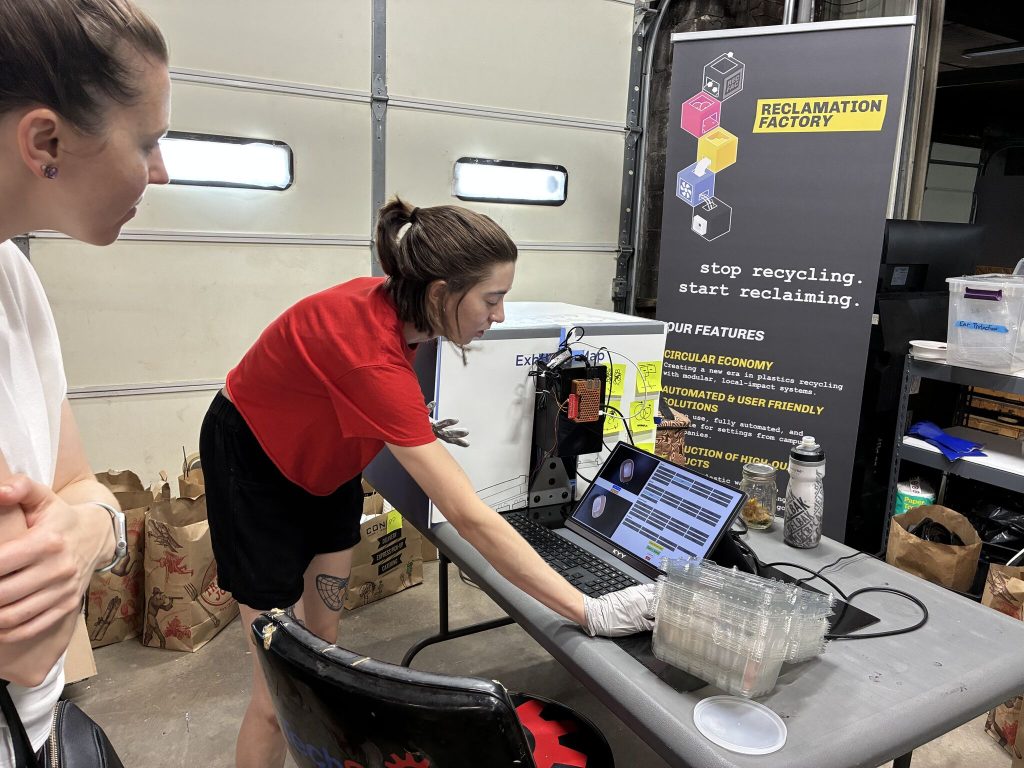
By analyzing how different materials respond to physical impact, the team built machine learning models to capture each material’s unique acoustic profile. Unlike visual or near-infrared systems, Acoustic AI is unaffected by color, shape, or surface appearance, so it can accurately classify plastics that have been shredded, crushed, or heavily pigmented. Trained on challenging black e-waste plastics, Acoustic AI achieved over 96 percent classification precision — proof that accurate, low-cost material recovery can break free of fragile, expensive optical systems.
With active pilots underway in e-waste, black plastics, and automotive recycling, Reclamation Factory plans to integrate its sensor suite directly into existing industrial conveyance systems. By owning that sensing layer, the company aims to unlock precise material recovery across the industry without requiring massive, cost-prohibitive processing facilities.
Reclamation Factory’s rapid evolution has been fueled by Pittsburgh’s collaborative innovation ecosystem. Through the Robotics Factory programs, a PGH Lab pilot with the City of Pittsburgh, and research partnerships with Carnegie Mellon University, Crowther leveraged technical expertise, customer validation, and real-world datasets to rapidly refine the company’s technology. Today, Reclamation Factory continues to build on those relationships to advance hyperlocal plastics recycling and pioneer next-generation sensing technology.