
 The cell therapy industry has reached an inflection point. While regenerative medicine is advancing rapidly, the “manufacturing” of living cells remains constrained by labor-intensive manual workflows, high variability, and massive costs. Launched in 2019, Cell X Technologies is transforming bio-manufacturing with an intelligent infrastructure designed to scale cell-based therapies. Through automated, repeatable workflows their cutting-edge technology reduces variability, minimizes manual intervention, and lowers both cost and risk for therapeutic developers and their patients.
Brian Handerhan, Chief Operating Officer at Cell X, was instrumental in bringing the company’s vision to life. During a two-decade career at Parker Hannifin, Handerhan led a Cleveland Clinic collaboration that developed the technology behind Cell X. Recognizing its disruptive potential, he championed the spin-off and signed on as Cell X’s first employee.
At the center of the Cell X technology stack is the Celligent platform, an integrated system that combines robotics, imaging, machine learning, and data capture to automate cell processing on a 24/7 production line. The platform reduces the risk of human error and significantly increases “walk-away time” for scientists, delivering the consistency and repeatability required for Good Manufacturing Practice (GMP) compliance.
To address the natural variability of living cells, Celligent uses bioadaptive automation to monitor cell growth, morphology, and behavior. Instead of relying on rigid programming or constant human oversight, the system uses machine learning to make real-time adjustments as needed. This adaptive intelligence enables Cell X to replace subjective manual decision-making with scalable, data-driven process control, improving reproducibility and reliability while reducing contamination events.
Solution
Cell X’s transition from prototype to production was expedited through its deep engagement with the Robotics Factory, where the team participated in both the Accelerate Program and a Scale residency. As part of the initial Accelerate cohort in 2024, Cell X worked closely with Senior Manufacturing Program Manager Matthew Verlinich and his team to bring structure to critical aspects of the business that had previously been informal. This included refining bills of materials, formalizing process documentation and standard operating procedures, and strengthening approaches to cash flow forecasting and risk management. For a team grounded in large-scale industrial experience, the program provided a clear framework for operating within a startup environment while still meeting the rigorous demands of cell therapeutics. Equally valuable was access to a broader network of business experts, technicians, mentors, and fellow founders, which opened new pathways for partnerships, hiring, and supply chain development.
Following Accelerate, Cell X entered the 2025 Scale Program, shifting focus to component design refinement and system manufacturability. Using the Robotics Factory’s shop space, specialized equipment, and on-site expertise, the team rapidly prototyped, tested, and iterated on subsystem designs without the overhead burden of a standalone facility. During this time, the Robotics Factory team continued to advise on design optimization, sourcing strategies, and manufacturer vetting.
An Innovation Works Scalable Grant further advanced progress by supporting two critical partnerships. Cell X contracted Pittsburgh-based Daedalus Inc. to redesign core components for manufacturability, including GMP-compliant single-use consumables integrated into automated workflows. The company also partnered with Leechburg-based Kiski Precision Industries to design and assemble the electromechanical system. The Robotics Factory build environment, along with targeted funding and expert manufacturer vetting, has helped Cell X mature its product and operations while remaining lean.
“The Robotics Factory helped us navigate the balance between moving fast as a startup and meeting the demands of a highly regulated industry.”
— Brian Handerhan, VP, Operations & Robotics, Cell X Technologies
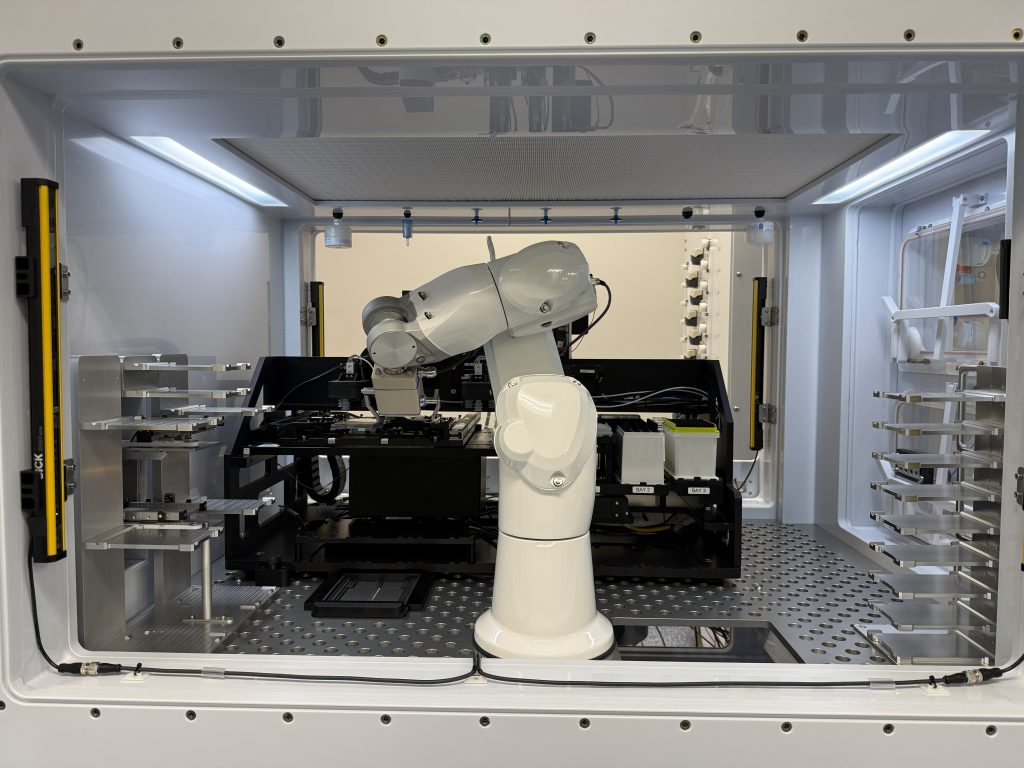 Through strategic partnerships with Aspen Neuroscience and BioLamina, Cell X has proven the flexibility of the Celligent system across complex therapeutic workflows. The platform integrates seamlessly into established development and manufacturing processes without requiring an infrastructure overhaul. By combining automated cell production with standardized, automation ready reagents, Celligent enables customers to improve consistency, reproducibility, and scalability with minimal disruption to active manufacturing lines.
Looking ahead, Cell X is moving beyond traditional automation to pioneer AI-driven process control. The company is refining its bioadaptive algorithms to create a platform that responds dynamically to each customer’s biological and operational needs, while laying the groundwork for proprietary AI models within the Celligent ecosystem. Ultimately, these advancements elevate the Celligent platform to critical infrastructure for scalable cell manufacturing, ensuring a defining role for Cell X in the future of regenerative medicine.