
For people who are blind or visually impaired, navigating a world designed for sighted individuals presents daily challenges that traditional tools, like white canes and guide dogs, can only partially address. ForSight Assistive Devices is dedicated to developing advanced sensory augmentation systems that provide users with a richer understanding of their surroundings, empowering them to navigate unfamiliar, dynamic environments with greater independence, confidence, and precision.
Founded in 2023, ForSight Assistive Devices is the brainchild of Dr. Lyman Petrosky, a Carnegie Mellon University Robotics Ph.D. who spent over three decades mastering autonomous navigation and real-time control systems at Westinghouse Electric Company. A prolific inventor with over 20 U.S. patents and two Nuclear Energy Institute (NEI) awards, Petrosky’s original inspiration came from a Star Trek character who could navigate flawlessly despite being blind. Since then, he has channeled his expertise into bringing that sci-fi capability to life.
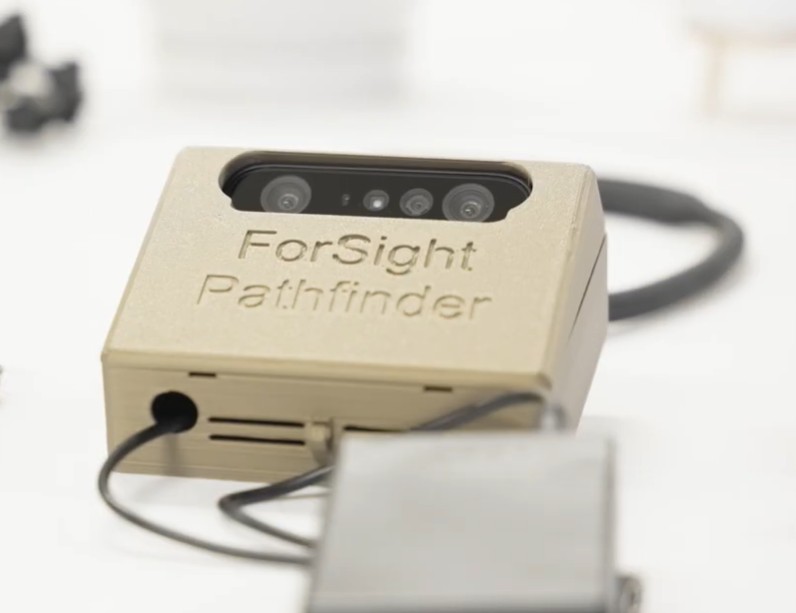
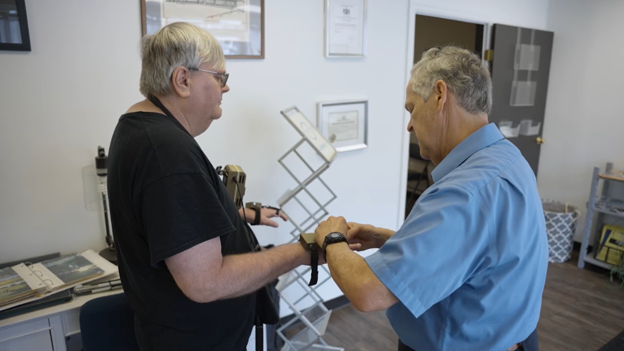
The company’s flagship product is Pathfinder, a wearable navigation device that leverages the advanced mapping and sensor technologies found in autonomous vehicles and mobile robots. Unlike traditional mobility aids, Pathfinder extends a user’s perception beyond their immediate reach. Using 3D sensors, the system scans and maps the environment up to 12-15 feet away. When obstacles or hazards are detected, Pathfinder sends a subtle vibration to the user through wearable pads. This haptic feedback allows users to understand their surroundings through touch without sacrificing their hearing or the use of trusted mobility tools. By augmenting—not replacing—existing navigation methods, Pathfinder fills critical information gaps and provides a new layer of environmental awareness for the blind and visually impaired.
Solution
Early engagement with Innovation Works helped advance ForSight from concept to commercialization. After securing a $15,000 Scalable Grant in 2023, the company spent the next two years advancing Pathfinder’s development within the Robotics Factory Accelerate Program. This ecosystem provided vital funding, networking, sourcing, and strategic business guidance to transition ForSight from a promising startup to a scalable enterprise.
Prior to Scalable Grant funding, Pathfinder existed largely as a founder-built system assembled from development boards, off-the-shelf components, and custom 3D-printed parts. While the technology demonstrated the concept’s potential, it was not designed for production. Through Robotics Factory and their Manufacturing Program engineer Tony Garcia, ForSight gained access to specialized vendors, contractors, and technical expertise that helped transform the device into a commercially viable product. Adept Electronic Solutions was brought in to lead electrical design work in support of high-fidelity haptic actuators, while Dynamic Manufacturing was contracted to fabricate the upgraded electronics. In parallel, JenRocket helped redesign and fabricate a more refined wearable form factor, packaging the electronics into a system that was both functional and physically comfortable.
Over three rapid development cycles, ForSight consolidated hours of manual assembly into a streamlined design, transforming Pathfinder from a labor-intensive prototype into a scalable, market-ready product. The results extended well beyond technical improvements. Pathfinder attracted strong interest at industry conferences, generated requests for early product samples, and inspired enthusiasm from organizations serving the blind and visually impaired community. During this period, ForSight also has applied for a patent for its unique spatial-information delivery system and raised $100,000 in seed funding to support the transition into initial production.
|
As Pathfinder approaches commercialization, ForSight is already exploring new ways to expand its impact. The company is partnering with EyeGuide, a smartphone-based navigation application that provides multifunction support for the visually impaired. The collaboration integrates EyeGuide’s advanced guidance software with Pathfinder’s haptic feedback capabilities. This parallel development path has the potential to deliver a lower-cost, highly accessible solution that leverages devices many users already carry and expands the reach of ForSight’s technology beyond its standalone wearable platform.
Looking ahead, Dr. Petrosky’s long-term goal is to build a sustainable company dedicated to creating a full portfolio of technologies for underserved disability communities. While the assistive tech sector has historically struggled to attract investment, ForSight is proving that life-changing innovation does not require a prohibitive price tag. By delivering advanced spatial awareness at a fraction of traditional costs, ForSight makes true independence universally accessible.