
Cattle ranchers face a costly lose-lose dilemma when managing invasive vegetation. Broadcast spraying douses entire fields in hazardous chemicals to hit scattered weeds, overapplying toxic herbicides and destroying vital native forage. Although manual spot treatment is more targeted, it exposes operators to harmful pesticides and demands intensive labor. On his family’s ranch west of Austin, Texas, Grant Wilkinson saw the problem firsthand when his mother, wearing a full respirator and heavy backpack rig, braved 110-degree heat to treat thistles by hand and protect her beloved bluebonnets from blanket spraying. That encounter ignited Wilkinson’s mission to limit chemical exposure by bringing precision AI automation to modern land stewardship.
After studying mechanical engineering at Rice University, Wilkinson joined Deloitte, where he developed AI-based vegetation management and wildfire prevention tools. To deepen his expertise, he came to Carnegie Mellon University (CMU) to pursue a master’s in AI Engineering. At CMU’s AI Venture Studio, Wilkinson teamed with co-founders David Seong and Aditya Pratama to develop the concept for Hermes Vision. The venture combines Wilkinson’s distinctive background with Seong’s expertise in autonomous robotics and Pratama’s experience developing agricultural technology solutions.
Launched in February 2026, Hermes Vision is developing hardware agnostic, AI-powered software that turns drone imagery into precision spray routes for invasive species. Survey drones map the terrain, AI identifies specific weed species, and automated route planning directs spraying equipment only where treatment is needed. With precision targeting, the system can cut herbicide use by up to 70 percent and reduce treatment costs roughly in half, while preserving native vegetation and keeping people out of the spray path.
The Solution
Joining the Robotics Factory Accelerate 2026 cohort provided Hermes Vision with the strategic clarity and technical environment needed to refine its business model. Despite being a software venture, the startup leveraged hardware labs, technical mentorship, and manufacturing expertise to optimize bill of materials economics, intellectual property protection, and fundraising strategies. Program mentors helped Wilkinson translate his consulting background at Deloitte into agile execution, driving customer discovery that pivoted the company’s go-to-market strategy to drone applicators.
Through the Keystone AgTech Alliance, Hermes Vision gained access to a broader network of agricultural partners across Pennsylvania. Designed to connect farmers with emerging technologies and accelerate innovation, the Alliance brings together Innovation Works, the Robotics Factory, Penn State, Team Pennsylvania, and the PA Department of Agriculture. Leveraging these connections, Hermes Vision demonstrated its technology to producers at Ag Progress Days.
“From an idea to proven technology in under a year. That transformation wouldn’t have happened without Robotics Factory and our mentors.”
— Grant Wilkinson, Co-Founder & CEO, Hermes Vision
Proving It in the Field
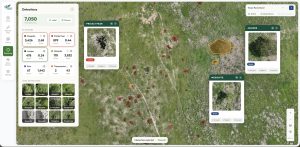 To support its refined market focus, Hermes Vision built a specialized drone simulation platform that accelerated model training and route generation across diverse topographies. This technical breakthrough directly fueled early customer traction across the country. In Texas, the team secured signed Letters of Intent with three commercial drone applicators, field-tested the technology with faculty and students from the King Ranch Institute for Ranch Management, and validated performance on a 350-acre ranch with a proven 50 percent reduction in herbicide use. Regionally, the team expanded operations by testing with Pennsylvania farmers and engaging in reforestation initiatives on abandoned surface mine lands across the Commonwealth.
What’s Next for Hermes Vision
As Hermes Vision targets full commercial deployment by 2027, the company is converting early pilots into recurring contracts and raising a pre-seed funding round. Led by Wilkinson and Seong, ongoing model training continues to sharpen the software’s species identification and route intelligence. Beyond weed management, the team is expanding platform capabilities into forest and orchard management as well as cattle inventory tracking. On the product roadmap, the team is actively securing necessary regulatory permits and certifications for heavy payload spraying drones to deliver a fully automated end-to-end pesticide control platform. Hermes Vision is also pursuing federal USDA and Small Business Innovation Research (SBIR) funding to help expand field deployment, with both appations currently under review.
Ultimately, Hermes Vision illustrates how targeted acceleration can transform a personal observation into an impactful, industry-changing business. By bringing AI and robotics directly to the range, Grant Wilkinson and team are establishing a smarter, safer, and more sustainable standard for agricultural stewardship. The company is delivering on the promise of agricultural robotics, replacing blanket treatment with targeted action that reduces chemical use, lowers costs, and protects people, animals, and the land.