
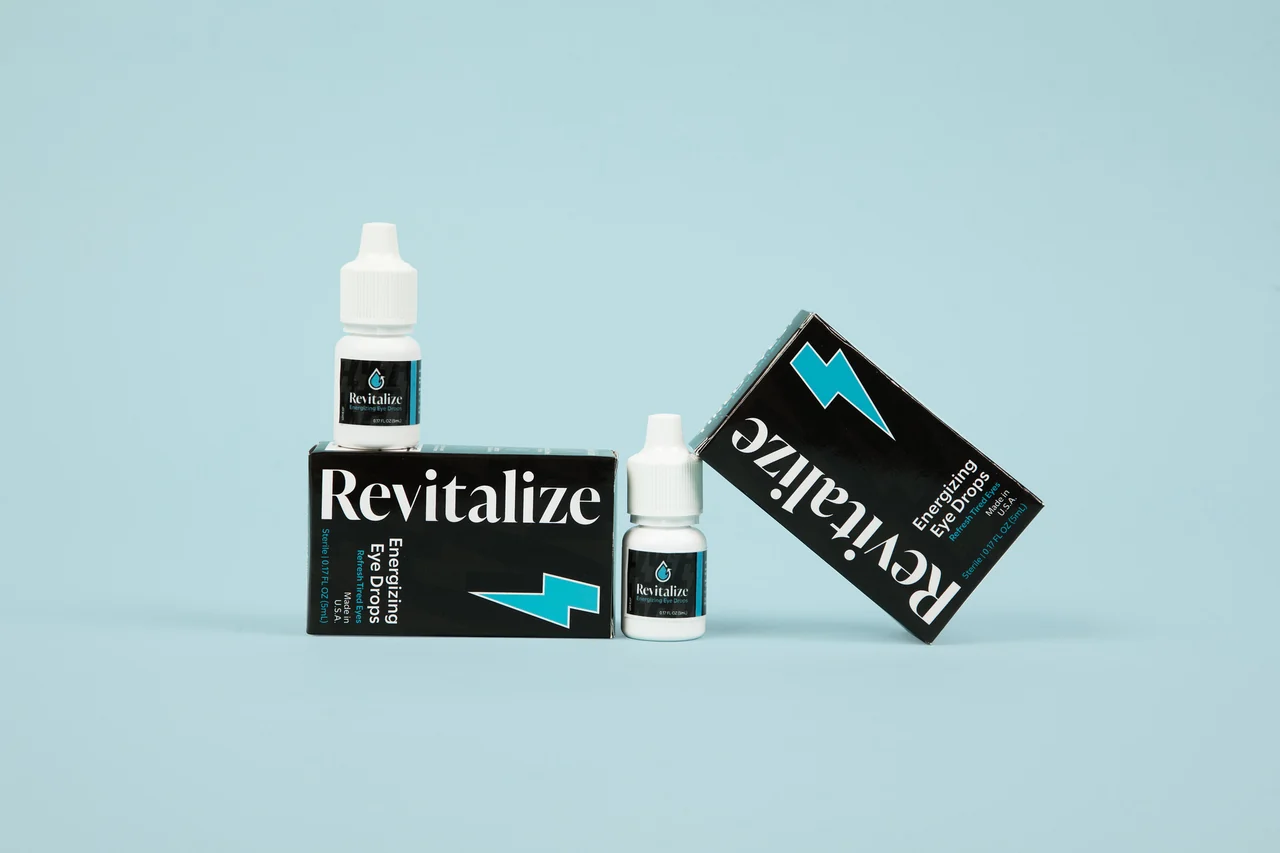
A Dorm-room Diagnosis
Guinness, founder of Revitalize Eye Care, was a student at the University of Pittsburgh when the idea found him, right as the pandemic was taking hold. “The concept of eye fatigue from digital devices became a problem that was much more relevant to a lot more people,” he said, and it pushed him toward a category he decided was “right for disruption.” He wanted more than a niche product. “I knew upon entering my journey into entrepreneurship, I wanted to create a household name,” Guinness said, drawn to products so embedded in daily life that people barely notice them: on store shelves, in the media people consume, sitting in their own homes.
He didn’t yet know how hard that category would be to break into. “Looking back, if I had to do it all over again, I would definitely not start in this category,” he said. “It is absolutely brutal.”
A Category No One Would Manufacture For
Guinness didn’t have a science background, so he partnered with contract developers who could translate his vision into a formulation that could legally be sold over the counter in the United States. The team drew inspiration from stimulant-based eye drops already popular in Japan and Korea, then worked to fit that concept inside the FDA’s approved monograph for over-the-counter active and inactive ingredients, a framework that leaves little room to improvise. “You can only do certain things for the product to be over the counter,” Guinness said.
Manufacturing turned out to be the harder problem. Eye drops have to be sterile, and every new formulation requires its own round of expensive certification before a contract manufacturer will run it. “It took me four years to spin up the current supply chain,” Guinness said, largely because so few facilities were willing to take on a new brand. Many of the manufacturers he approached were vertically integrated and sold competing products of their own, which made a genuine partner hard to find. Revitalize even switched manufacturers once along the way after running into problems with an earlier partner. “We’re very thankful for our manufacturing partner,” he said of the company that ultimately took them on. “They’re fantastic to us, and they have been a huge help.”
The timing didn’t help. Revitalize launched in August 2023, four months after what Guinness called the largest recall in eye drop history, triggered by an overseas manufacturer that skipped quality checks. “We launched into… the most distrustful market when it came to eye drops, especially as an emerging brand,” he said. “Who the heck is going to trust an emerging brand after the largest recall?” The company leaned hard on its United States manufacturing story to rebuild that trust from scratch.
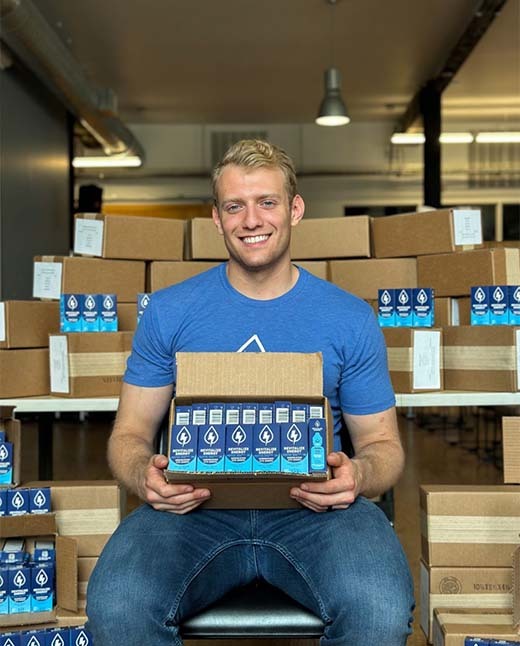
Ascender, AlphaLab, and Building the Pipeline
Guinness’s path into Innovation Works’ AlphaLab accelerator wasn’t a straight line. He applied while he was still a student at Pitt, a year or two before he was actually accepted, and was turned down. “We were not selected because we were not ready,” he said. “But we were given feedback on what we needed to do, and that kind of set us on a path.”
Rather than shelve that feedback, Guinness took it into Ascender, a separate Pittsburgh accelerator, and built his plan for that program directly around what AlphaLab had told him he was missing.
“I think the reason we were able to get as much out of [Ascender] as we did is because we went to AlphaLab, got feedback on, ‘Hey, this is why you are not ready, do these things.’ So then when we were accepted into Ascender, we had a very clear list of what we needed to get out of this program.”
— Kyle Guinness, Founder, Revitalize Eye Care
By the time he reapplied to AlphaLab, after graduating from Pitt and spending about a year in a corporate job while working through Ascender, he was ready to use it. “I would safely say that we got much more out of AlphaLab than I ever thought we would have,” Guinness said. “Our supply chain would not have been built, and we would not have launched the product… without the programming that we received.” Beyond the funding that covered production deposits, he credits AlphaLab with teaching him how to negotiate with manufacturers and weigh competing quotes, the exact skills that got Revitalize’s supply chain off the ground.
Guinness also credits an unrelated skill for keeping him in the game long enough to reapply to the program: sales. Before founding the company, he sold advertising for the student newspaper at Pitt and worked sales internships at ADP and Cintas, including door-to-door style pitches in Staten Island in 95-degree heat. “That kind of sales cycle… really impacted me in a positive way,” he said. “It gets you very used to rejection, and the business world is so full of rejection.”
From Cold Calls to Amazon’s Top Shelf
With a supply chain finally in place, Guinness turned to distribution and got the first call wrong. Revitalize launched directly to consumers, running Facebook ads and testing TikTok. “That was objectively wrong,” he said. “I almost blew up the company because I wanted to be right.” The product’s price point couldn’t absorb the cost of acquiring customers online, and repeat purchases, which he’d expected monthly, were coming every 60 to 75 days instead.
Guinness pivoted to business-to-business sales, drawing on the same instincts that got him through those Staten Island sales calls. “To start, it was me on my phone cold calling local pharmacies and local businesses, tracking sales in an Excel sheet and showing up in my friend’s car because I didn’t even have one,” he said, carrying samples and closing pharmacies one case at a time.
That grind funded the company’s launch on Amazon, where Revitalize broke out. “We were the number one new release product in Vision Care at one point across all of Amazon as a one-SKU company,” Guinness said, “I think top ten in eye drops, which is absurd,” with a consistent 4.4 to 4.6 star rating. The company sold out faster than expected, and its manufacturer delivered the bad news: the fill line was booked for the next eighteen months.
A Seed Round When It Mattered Most
We had to raise to keep the production line running. We had proven demand and repeat orders. But were faced with “out of stock” messages on our retail channels.
Raising money with strong sales history but no product to sell is a hard pitch. “We’ve had six months of really good sales data, and then, yeah, we’re not selling right now” is how Guinness describes the pitch that made most investors hesitate. Through its seed fund, Innovation Works was the exception. “Innovation Works knew who we were, knew the challenges that we had faced, and understood what we were trying to do,” he said. “They were willing to take another bet on us, a vote of confidence that helped pull other investors into the round.”
The Acquisition and What Comes Next
Droptics, a retail-savvy eye care brand with relationships at chains like Walmart, had already been licensing Revitalize’s formulation under its own label for some time before deciding to acquire the company outright. “They had been licensing the technology for a little while under their own label and were really happy with how the product was performing,” Guinness said. The fit made sense from both sides: Droptics had the retail distribution Revitalize never built, and Revitalize had the regulatory and manufacturing groundwork Droptics didn’t want to build from scratch. “It was kind of a match made in heaven,” Guinness said. “They knew the retail game in a way that we did not, and we understood the supply chain and regulatory landscape and formulation game in a way that they did not.”
Guinness credits Kevin Dowling, Innovation Works’ Managing Director for hardware and robotics investments, with talking through the acquisition decision with him before he committed, a conversation that was supposed to last thirty minutes and ran closer to two hours. Looking ahead, Guinness wants to be a founder again, eventually. “I don’t want this to be my only company,” he said, but he’s waiting for an idea worth the sacrifice a launch requires. His advice to founders just starting out: “Most people are just as scared as you. The best thing you can do is start, and for as much as you want to plan everything out, nothing will go to plan. So be ready to adapt.”