
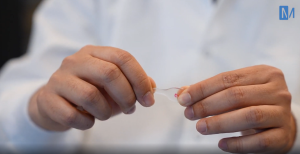
Before biomedical scientists can run a new preclinical test, they often spend days or weeks hand-building the custom tools, microfluidic chips, and tissue scaffolds their experiments require. Mimetic was founded to remove that bottleneck. The Pittsburgh startup is building an automated platform that 3D-prints biocompatible silicone devices and human tissue models, giving drug developers a faster, lower-cost path to more human-relevant data.
A Slow, Expensive Starting Line
Many lab devices rely on silicone to safely culture human cells, but traditional silicone fabrication depends on costly injection molds that can stall prototype production for weeks. Preclinical testing also still leans heavily on animal models, which can cost tens of thousands of dollars each and frequently fail to predict how a drug will perform in the human body.
The life sciences industry needs a platform that pairs rapid benchtop microfabrication with human-relevant tissue models. One that can bypass cleanroom delays, cut costs, and reduce reliance on animal testing.
From DIY Printers to Printable Silicone
 Kevin Dai has been building things since his early days assembling DIY 3D printers. After studying mechanical engineering at Georgia Tech, he earned a PhD at Carnegie Mellon University specializing in soft robotics, where he developed flexible materials and soft robotic parts. That work gave him a front-row view of how slow and costly silicone injection molding could be.
High-precision silicone had historically resisted direct 3D printing. Kevin set out to change that, using CMU’s Innovation Commercialization Fellowship to pioneer new biocompatible material chemistries and printing hardware. He founded Mimetic in 2024.
Outgrowing the Makeshift Lab
Early on, Mimetic worked out of a makeshift wet lab with a single indoor fume hood, which strictly limited the chemical reactions the team could safely attempt and slowed progress in polymer chemistry. Standard commercial 3D printers created a second problem: each run required pouring large volumes of resin, so the team burned through expensive, custom-synthesized materials during basic calibration tests.
The business side needed focus, too. Mimetic’s market was broad and undefined. The emerging answer was to move downstream, using its materials and precision printing to build realistic organ-on-a-chip models for drug development. Organ chips are small devices lined with living human cells that mimic how an organ functions, giving researchers a closer read on how a drug will behave in people. Making that shift from general material supplier to focused life sciences platform would take specialized chemical facilities, modified hardware, and strategic guidance.
Lab Space, Better Hardware, and a Sharper Focus
Innovation Works and the Robotics Factory gave Mimetic the environment to push both the science and the business forward.
Call out: “AlphaLab and the Robotics Factory give us access to a fully fleshed-out prototyping facility with every tool we need to fabricate our hardware. Getting involved was a no-brainer.”
—Kevin Dai, Founder, Mimetic
Lab space at AlphaLab Health was a major unlock. With fully equipped chemical fume hoods, Kevin’s team safely expanded its chemistry research and, over six months, achieved breakthroughs in novel silicone synthesis reactions and stronger material formulations. That work accelerated development of biocompatible materials that can support living cells, moving Mimetic closer to a commercially viable printing material.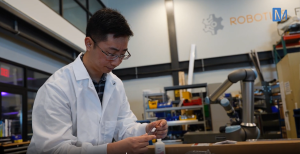
At the Robotics Factory, the team worked alongside Andrew Katon, Innovation Works’ electromechanical engineer with deep 3D printing experience, to modify its printers for low-volume fluid dispensing. The changes let Mimetic run material characterization tests with half a vial of resin instead of a standard cup-sized vat.
Mentorship from AlphaLab Health Program Manager Kelsie LaBarbara, along with mock advisory boards and structured customer discovery bootcamps, helped Mimetic narrow its aperture. The company shifted from general 3D printing materials to high-impact organ-on-a-chip microfluidic models, with lung cancer therapeutic efficacy as its initial beachhead. The result: an open-ended materials vendor became a targeted life sciences partner that can show clear value to pharmaceutical R&D leaders.
Building Toward a Same-Day Lab
Mimetic is now executing a phased commercialization strategy that pairs near-term material sales with long-term platform development. While working toward full platform validation, targeted for 2028, the company is preparing to sell its finalized biocompatible 3D printing materials to academic and research markets.
On the clinical side, Mimetic is advancing research collaborations, including a National Institutes of Health proposal with Boston Children’s Hospital to study microvascular capillary blood vessels. The team is also engaging prospective partners at institutions such as the University of Pittsburgh and Cedars-Sinai, while converting early biotech interest into Letters of Intent and pilots ahead of its pre-seed round.
By moving from fundamental materials research to an automated preclinical testing platform, Kevin and his team are taking apart long-standing barriers in biomedical manufacturing. As Mimetic advances its organ chip models, the company is positioned to lower drug discovery costs, reduce reliance on animal testing, and speed up life-saving medical innovation.