
Born at the intersection of aerospace engineering and robotics, Near Earth Autonomy is redefining the boundaries of autonomous flight. The company develops advanced perception and control technologies that enable helicopters, drones, and other aerial platforms to navigate challenging environments, execute precise landings, and complete critical missions with minimal to no human pilot intervention. By reducing reliance on GPS, external communications, and other flight infrastructure, Near Earth is expanding the reach of uncrewed aircraft across industries ranging from infrastructure inspection and cargo delivery to national defense.
 Delivering these capabilities requires a precise bridge between experimental robotics and rigorous operational reality. Senior Technical Project Manager Kris Fosmoe brings a background in defense modernization to that mission, overseeing the integration of aircraft-agnostic autonomy into multiple platforms. His experience ensures that sophisticated technical stacks mature into seamless, scalable solutions that can be readily deployed by warfighters and civilians alike.
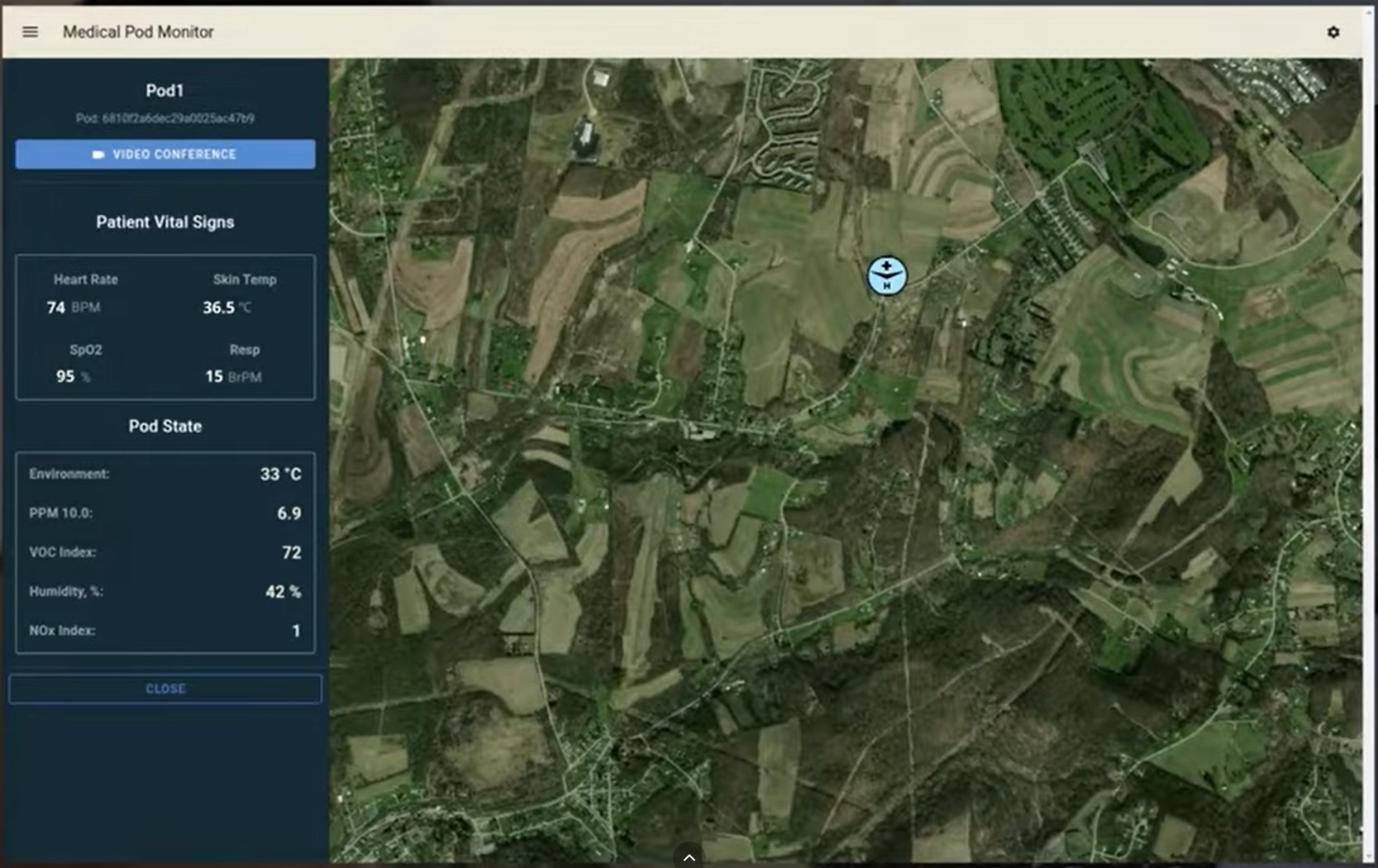
Near Earth’s advanced autonomy has clear implications for battlefield casualty evacuation, where survival depends on receiving care within the sixty-minute “golden hour” window. Leveraging decades of experience in autonomous logistics, the company is now working alongside the U.S. Army and LIFT Aircraft to redefine medical retrieval in contested environments. Led by Fosmoe, the team developed a modular multi-mission payload designed to deliver temperature-sensitive blood and medical supplies and then rapidly transition to evacuate casualties. This self-contained pod provides continuous environmental and patient monitoring to protect the critical cargo, while transmitting real-time telemetry to remote personnel throughout the flight.
Solution
By the time Fosmoe and the Near Earth team connected with Innovation Works at a Pittsburgh Technology Council event in 2024, the concept for the dual-purpose medical pod already existed. The critical next step was transforming those engineering requirements into a functional, manufacturable prototype. Utilizing a Scalable Grant helped offset the cost and risk associated with building the first-generation system, allowing the team to move from drawings and requirements to a fully integrated physical payload.
To ensure the system reflected the realities of emergency medicine, Near Earth consulted Dr. Lenny Weiss of the University of Pittsburgh, Medical Director at STAT MedEvac and director of one of the nation’s largest air-medical transport networks. Guided by these real-world clinical demands, the team engineered a modular pod that quickly converts to match the mission profile. The pod functions as a closed, climate-controlled cargo container to protect sensitive medical supplies and blood, then quickly transforms into an open configuration optimized for casualty transport. The physical design also allows a patient to remain securely strapped in their litter or military stretcher throughout the evacuation process.
The architecture directly solves the critical challenge of maintaining a strict medical cold chain in flight. The pod specifically accommodates standard Collins boxes packed with blood products, a wireless temperature sensor, and a top-placed ice bag. By feeding this data into an onboard computing hub, the system continuously tracks internal thermal stability, air quality, and patient vitals. The final design allows an operator to instantly toggle the software between dedicated blood transport mode and evacuee tracking mode, ensuring remote, medical teams have real-time visibility throughout the entire mission.
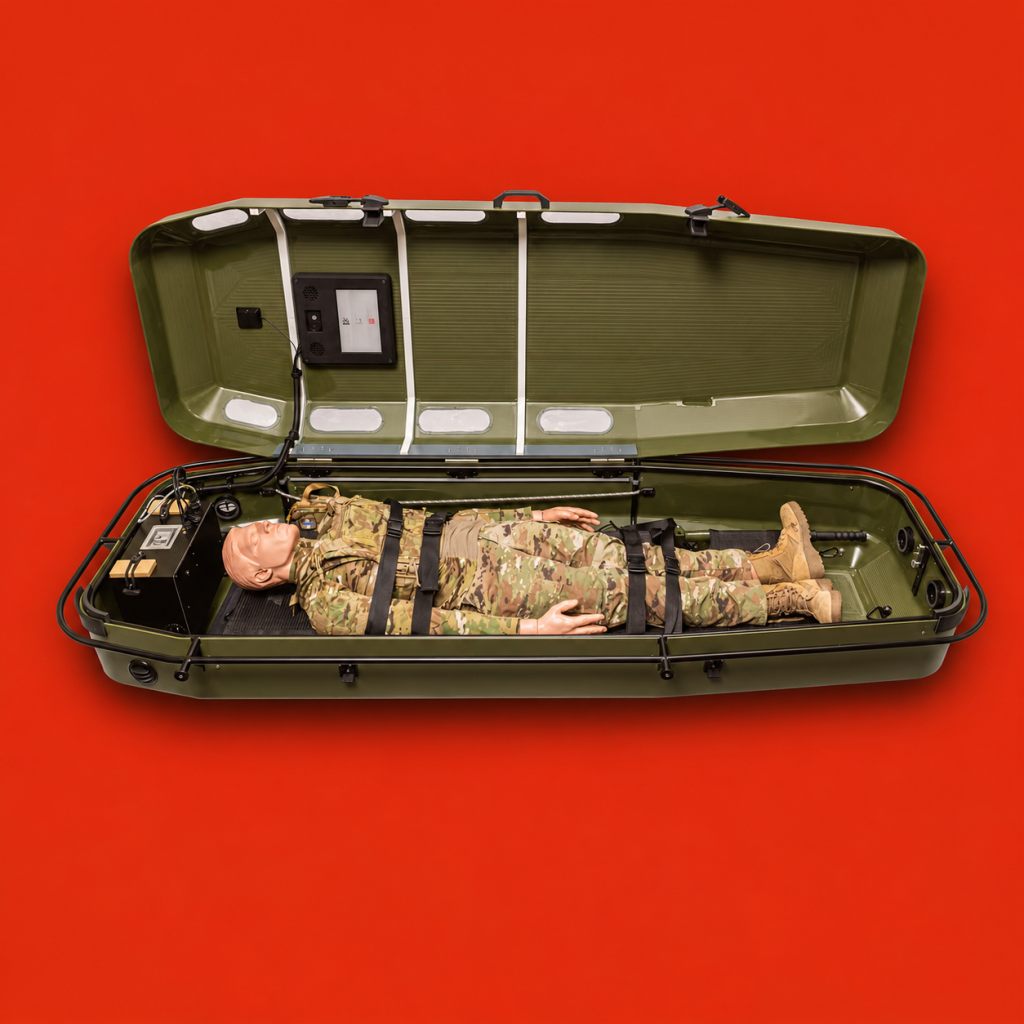
Building the rugged capsule shell and custom metal framework required precise manufacturing expertise.
Innovation Works’ engineer Tony Garcia helped line up the ideal partner for the job by connecting Near Earth with Beaver Falls-based Kenson Plastics. Keeping the fabrication process local ensured a rapid turnaround on the prototype enclosure. The resulting design is entirely platform-agnostic, allowing it to interface seamlessly with Near Earth’s autonomous helicopters as well as standard military air and ground vehicles. Rather than custom-building separate housing for each component, the team focused on dense systems integration, packing the entire climate control, telemetry, and power architecture directly into a singular, ruggedized footprint.
|
The project reinforced the advantages of building in Pittsburgh. By tapping into a network of regional manufacturers, technical experts, and funding partners, Near Earth drastically accelerated development and minimized risk. Innovation Works served as the critical catalyst, uniting these fragmented local strengths into a sharp competitive advantage that cements Pittsburgh’s reputation as a prime hub for breakthrough aerospace robotics engineering.