
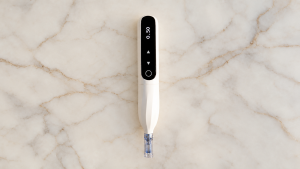
 Vaera Skincare is building a handheld microneedling pen engineered to close the gap between expensive in-office treatment and unreliable consumer devices. With support from Innovation Works, AlphaLab, and the Robotics Factory, founder Justin Seth has taken the Vaera Pen from a kitchen-table teardown to a validated v3 prototype headed for a Kickstarter launch.
An Engineer at the Kitchen Table
In 2023, while studying mechanical engineering at the University of Pittsburgh, Justin Seth was looking for a solution to his thinning hair. He turned to microneedling, a clinical dermatological treatment now widely available through at-home devices. As Seth began using those products, he noticed that the consumer-grade devices fell drastically short of professional standards. Built with loose tolerances, imprecise needle movement, and ambiguous instructions, existing options offered little technical rigor, suggesting they had been designed to be inexpensive and functional rather than precise.
Naturally, Seth approached the problem through an engineering lens. With assistance from one of his professors, he analyzed the internal mechanics of these devices to evaluate needle entry dynamics and motor precision. Those findings provided the blueprint for Vaera Skincare, with a mission to disrupt and democratize the under-engineered home microneedling market.
Precision Over Gimmickry
Vaera advances everyday dermatology by anchoring its technology in rigorous mechanical design over cosmetic gimmickry. After more than two years of intensive development, Seth and his team have designed the Vaera Pen, a handheld microneedling pen with a high-speed motor and sensor system. By ensuring tightly controlled needle actuation, the device eliminates the slow, inconsistent movement common to legacy devices. The goal is cleaner, more uniform micro-channels with less drag and discomfort, creating an elevated experience that more closely reflects professional treatment.
Vaera is ultimately targeting the space between two extremes: the high cost of in-office microneedling and the limitations of unreliable consumer devices. At its core, the company is built around a simple premise Seth discovered while taking apart microneedling devices at his kitchen table. Better results do not necessarily require more technology. They require better engineering.
Proving the Premise
For Vaera, the challenge was to turn a promising engineering concept into a practical prototype with the precision, consistency, and safety that consumers expect from professional treatment. Existing at-home devices rely on slower needle movement and repeated passes over the same area, creating unnecessary overlap that can increase skin trauma. Vaera is built around a different premise: microneedling works best when needle movement is controlled and predictable, rather than driven by deeper penetration or repeated force.
Turning that philosophy into hardware required Seth and his team to move beyond early design work and build a functional prototype of the Vaera Pen. The company needed to validate its mechanical approach, refine the device’s components, and demonstrate that its high-speed actuation system could translate into a safer, more controlled consumer experience.
Two Passes Through AlphaLab
After building an initial prototype using an Arduino microcontroller kit, Seth recognized that a one-off proof of concept was a far cry from a scalable venture. Seeking the infrastructure and technical support needed to transform his raw idea into a market-ready offering, he applied to AlphaLab. Though he narrowly missed the deadline for the 2024 cohort, Vaera was still able to participate in much of the programming and received an initial $25,000 Innovation Works Early Stage Technology Assistance Grant.
Seth applied again for the following AlphaLab cohort and was accepted in 2025, giving him the opportunity to go through the program twice while scaling the company’s technical and operational foundations simultaneously. The experience proved transformative, providing both the capital to refine the hardware and the strategic playbook needed to launch a venture-backed company.
“Being an entrepreneur goes beyond engineering. Innovation Works gave me the tools to navigate marketing, finance, and fundraising, reinforcing the skills I need to grow Vaera.” — Justin Seth, Founder & CEO, Vaera Skincare
Under the Microscope at the Robotics Factory
Vaera’s technical design matured significantly after joining the Robotics Factory Accelerate Program in 2026. Manufacturing program associate Tony Garcia and electrical prototyping engineer Brian Dougherty became sounding boards and hands-on partners to Vaera. The redesigned pen prototype required specialized electronics and components small enough that assembly and soldering had to be performed under a microscope. Through the Robotics Factory Scale Shop, Seth gained access to specialized equipment and worked closely with Dougherty to master circuit design and the painstaking technique of micro-soldering required to assemble the electronics.
The Robotics Factory team provided an important system of checks and balances, challenging design decisions and helping Seth identify problems that were difficult to see from inside the project. During testing, for example, Dougherty discovered that one of the device’s sensors was highly sensitive to temperature, effectively turning it into an unintended thermometer. That finding sent the team back to the drawing board, where they redesigned the circuitry to eliminate the flaw entirely.
With a redesigned motor and upgraded electronics, the Vaera Pen v3 delivers high-speed, high-precision actuation that reduces skin trauma and eliminates treatment variability. Bringing that technology to market required more than engineering, which is where AlphaLab and the Robotics Factory proved essential. The accelerator environment pushed Seth to re-evaluate his hardware with a focus on long-term reliability and scalable manufacturing. Concurrently, the programs helped him complete more than 200 customer discovery interviews and build an advisory network within the industry, giving Vaera both a validated technical architecture and a clear roadmap for commercial launch.
Built for What Comes Next
Vaera’s next chapter begins fall of 2026 with an October Kickstarter campaign, opening pre-orders with exclusive discounts for those on the waitlist. With thousands of prospective customers signed up already, the company is building momentum toward beta testing, final design, and full-scale manufacturing over the next six to twelve months. And the flagship pen is just the beginning. It gives Vaera the engineering foundation to take its precision-first approach beyond microneedling and into a broader generation of at-home skincare technology.